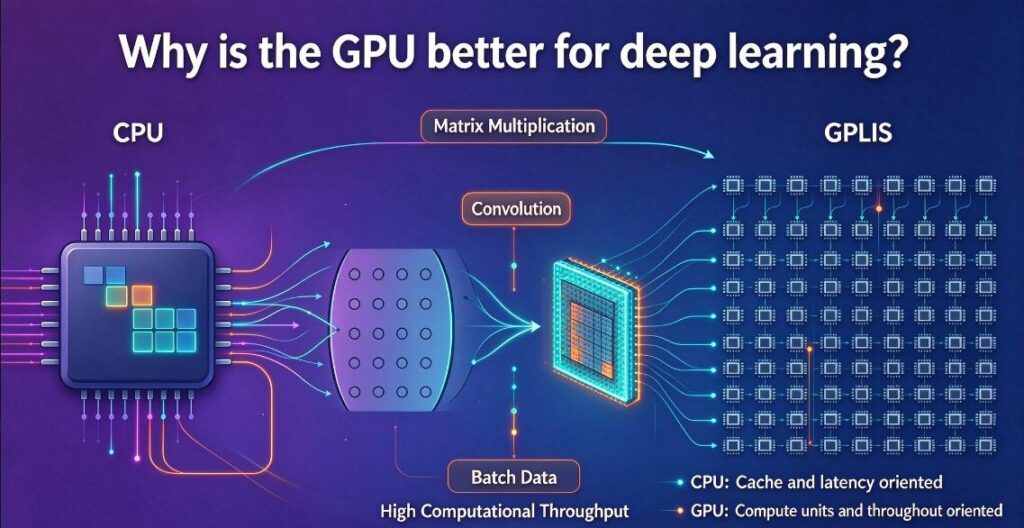
GPUs are better suited for large-scale parallel computing, and the fundamental reason lies in their different architectural priorities: CPUs are optimized for low-latency serial execution, while GPUs are optimized for high-throughput data parallelism.
Core count: CPUs typically have 4–64 powerful cores, optimized for complex control, branch prediction, and out-of-order execution. GPUs feature thousands of lightweight cores (tens of thousands of CUDA cores in an H100, for example). Each core is simple, yet they vastly outnumber CPU cores.
Execution model: GPUs adopt SIMT (Single Instruction, Multiple Threads). One instruction runs across massive threads simultaneously, which naturally matches workloads where the same operation is applied to large volumes of data, such as matrix multiplication, pixel processing and gradient computation.
Video memory bandwidth: GPUs are equipped with high-bandwidth memory (HBM) reaching several terabytes per second, eliminating the bottleneck where computation outpaces data supply. CPU memory bandwidth is an order of magnitude lower.
Floating-point throughput: Low-precision units such as FP16 and INT8 deliver far higher FLOPS for AI training and inference compared with CPUs.
Applicable boundaries: CPUs perform better on irregular, heavily branched, low-parallelism tasks like operating system routines and business logic. GPUs excel at regular, highly parallel workloads including rendering, scientific computing and neural network operations.