Large models (including various Agent frameworks) are growing increasingly capable. However, once they interface with the physical world — for example, controlling robotic arms or autonomous vehicles — safety safeguards implemented purely in software become extremely fragile. If the large model hallucinates, or falls victim to prompt injection attacks, it may bypass safety checks embedded in code (such as skipping a simple `if(danger) stop()` routine). Existing software‑based watchdogs are ineffective the moment the system crashes.
My preliminary reasoning
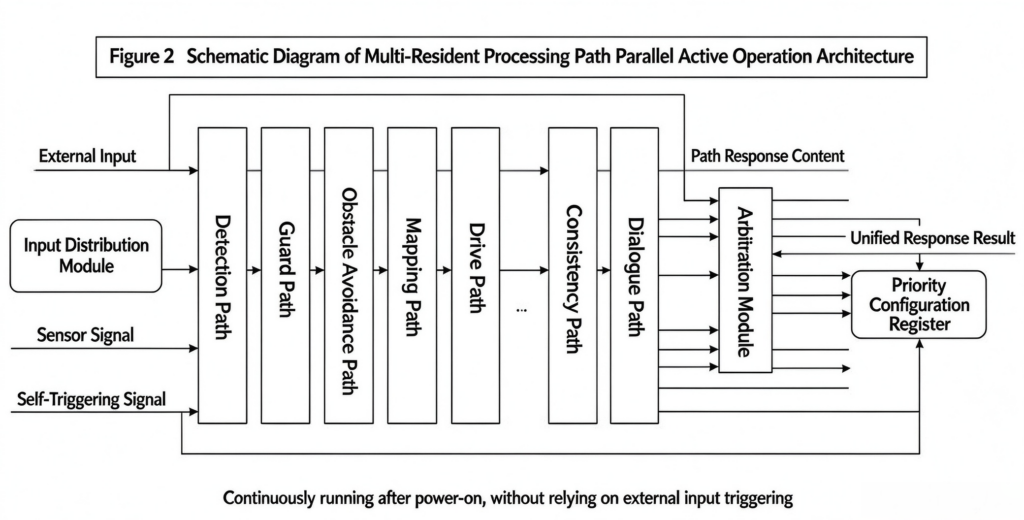
I have devised a mechanism built around an **intermediate decision layer** and **FSM physical fuse**. The core idea is this: rather than relying on OS scheduling, the human supreme safety authority is hardwired into low‑level chip registers. All external data must pass through a **unidirectional physical air gap gate** for cross‑validation before reaching the core. If conflicts or out‑of‑bounds conditions are detected across multiple signal paths, a hardware arbiter immediately cuts power and enforces a physical hard reset.
Operational environment, software version and other related information
This work is currently at the stage of conceptual deduction and underlying architecture design, with no concrete code implementation available.
I would like to consult the low-level hardware experts :
If we intend to forcibly add this hardware-enforced physical hard-reset safeguard onto existing chip architectures, for engineering implementation, are the biggest roadblocks the power budget limit and clock synchronization? Or is it fundamentally impossible to decouple the black-box internal states of large models?
Feedback and discussions from peers specializing in low-level hardware and AI safety are highly welcome. Please feel free to share alternative physical isolation schemes if you have any.
Expert Opinion
Memorizing terminology does not guarantee practical proficiency. I only connected those terms together after getting a minimal working example up and running. Your question was: “If we really try to add this hardware-enforced physical hard-reset safeguard onto existing chip architectures for real-world engineering deployment…” What follows are the approaches that have proven effective from my hands-on trials.
Learning to use something first before circling back to grasp its underlying principles is far more efficient than obsessing over formal definitions.
The reason you may know terms by heart yet still struggle to apply them is simply that you have not run a practical test yourself.
In one sentence: At its core, an Agent breaks down **well-defined problems** into executable steps, which are then handed over to the model or tools for completion.
A few targeted points relevant to your line of work:
· Agent: First get the minimal loop of **planning → tool calling → observation → reflection** working. Do not rush into complex multi-agent setups. Tool descriptions and error handling are what determine an Agent’s stability.
Stick to the core logic when learning and avoid getting tangled up in jargon. Master practical usage first, then revisit the theory — this is the most efficient path.
I recommend learning alongside a minimal runnable example rather than only reading definitions.
Three self-check questions you can use right away:
① How does the output change when the input changes?
② What capability is lost if this layer is removed?
③ Under what conditions does this mechanism fail to hold?
If you can answer all three, you truly understand it.
I have only outlined the primary workflow above. Failures almost always occur in edge branches. What kind of errors have you encountered? Paste them in the comments, and I will help you review them.